

Protein engineering requires identifying rare beneficial variants within a vast sequence space, often using limited experimental measurements. Machine learning-directed evolution frameworks like EVOLVEpro address this challenge by pairing protein language model (PLM) embeddings with few-shot regression. However, EVOLVEpro averages embeddings across the entire protein, which can dilute critical signals concentrated in catalytic, regulatory, or interaction regions. To resolve this, researchers tested whether functional-region-aware embeddings could improve variant effect predictions using single-mutant deep mutational scanning datasets for TEM-1 β-lactamase and MAPK1/ERK2. ESM-2 embeddings were pooled across mutation-centered, active-site, and protein-specific regions, with full-dimensional regional embeddings delivering the strongest overall performance. In virtual evolution trials, mutation-centered and active-site representations identified high-activity variants at markedly higher rates than whole-protein pooling. These results demonstrate that functional-region-aware representations preserve activity-relevant details often lost to global averaging, supporting more biologically informed design in PLM-guided protein engineering.
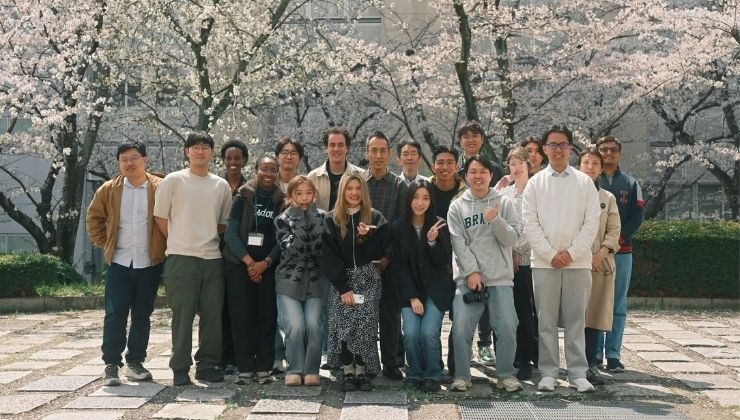

Conducting independent research at Osaka University fundamentally transformed how to approach computational science, shifting the perspective from using computation merely to explain experimental results to using it to decide which experiments to run. The experience provided critical practical training in machine learning, protein language models, and reproducible research while fostering the independence to make scientific decisions and navigate complex results with confidence. Working within an international research group also reinforced the value of clear communication across cultural and disciplinary boundaries. By bridging the experimental, physics-based foundation built at Berkeley with Osaka's data-driven, sequence-level approach, the program clarified a definitive path forward: pursuing a PhD in computational biology to design methods uniting wet-lab chemistry, molecular simulation, and machine learning for protein engineering.
Ralph Vincent Mariano